| Prep Time | 30 minutes active |
| Autolyse Rest | 1 hour |
| Bulk Fermentation | 4-6 hours (includes stretch and folds) |
| Cold Proof | 8-12 hours (overnight) |
| Bake Time | 45-50 minutes |
| Cooling Time | 2 hours |
| Total Time | Approximately 16-20 hours |
| Intensity Level | Moderate (requires planning and patience) |
| Yield | 1 large loaf (approx. 900g) |
| Difficulty | Intermediate |
Intensity Breakdown
| Phase | Intensity (1-5) | Notes |
|---|---|---|
| Mixing dough | 2/5 | Simply combining ingredients |
| Stretch and folds | 3/5 | Requires gentle, deliberate technique |
| Shaping | 4/5 | Sticky dough can be challenging |
| Scoring | 3/5 | Chocolate pieces add resistance |
| Baking | 2/5 | Mostly hands-off |
Why This Recipe Works
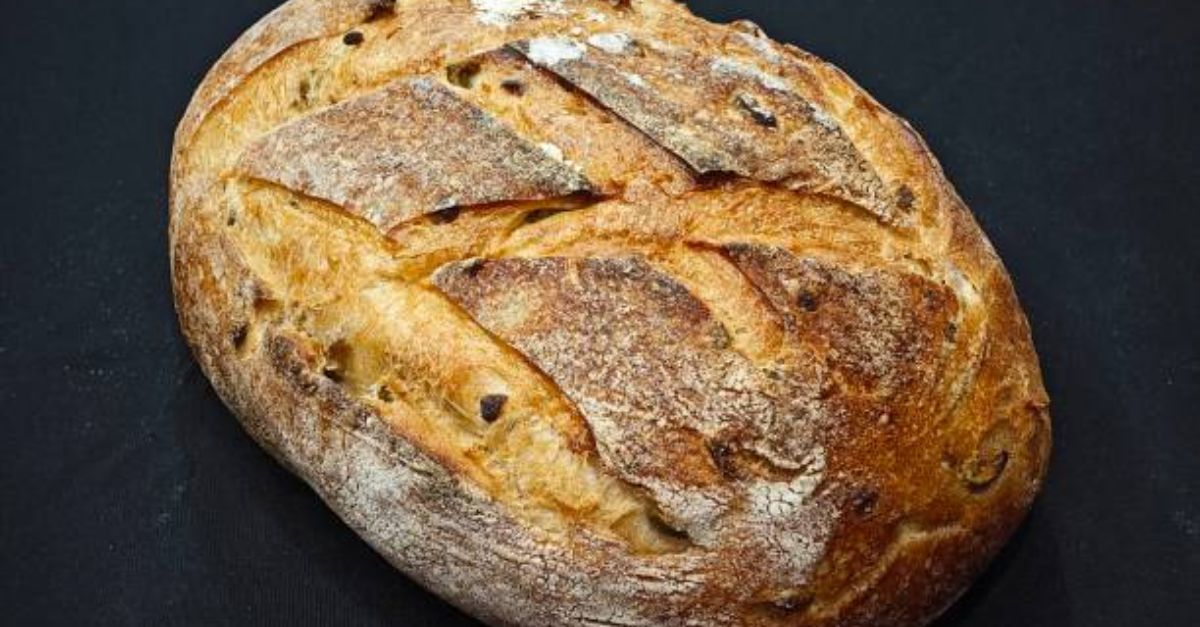
This chocolate chip sourdough bread strikes the perfect balance between a classic country loaf and an indulgent treat. The natural tang of fermented dough complements the sweetness of semi-sweet chocolate chips, while the open crumb structure creates pockets of melted chocolate throughout. Unlike quick breads or enriched doughs, this recipe maintains the signature sourdough crust—crisp, deeply browned, and crackling—while delivering a tender, airy interior studded with chocolate.
Ingredients
For the Levain (prepare 4-6 hours before mixing)
| Ingredient | Weight | Volume |
|---|---|---|
| Active sourdough starter (100% hydration) | 50g | ¼ cup |
| Bread flour | 50g | ⅓ cup + 1 tsp |
| Whole wheat flour | 50g | ⅓ cup + 1 tsp |
| Filtered water (85°F/29°C) | 100g | ¼ cup + 3 tbsp |
For the Dough
| Ingredient | Weight | Volume |
|---|---|---|
| Bread flour (12-13% protein) | 400g | 3 cups + 2 tbsp |
| Whole wheat flour | 50g | ⅓ cup + 1 tbsp |
| Filtered water (90°F/32°C) | 320g | 1⅓ cups |
| Levain (all of the above) | 250g | All |
| Fine sea salt | 10g | 1¾ tsp |
| Semi-sweet chocolate chips | 150g | ¾ cup + 2 tbsp |
| Rice flour (for dusting) | As needed | As needed |
Equipment Needed
-
Digital kitchen scale (essential for accuracy)
-
Large mixing bowl (4-6 quart)
-
Dough whisk or wooden spoon
-
Bench scraper
-
Two large bowls or proofing containers
-
Dutch oven (5-7 quart, cast iron preferred)
-
Parchment paper
-
Banneton proofing basket (or bowl lined with floured towel)
-
Shower cap or plastic wrap
-
Spray bottle (optional)
-
Lame or sharp razor blade
-
Wire cooling rack
Method
Day 1 (Evening – 4-6 hours before mixing)
Step 1: Feed Your Starter
Begin with an active, bubbly starter that has been fed within the last 12 hours. Mix 50g starter, 50g bread flour, 50g whole wheat flour, and 100g warm (85°F/29°C) water. Cover and let sit at room temperature (70-75°F/21-24°C) for 4-6 hours. Your levain is ready when it has doubled, shows bubbles on top and sides, and passes the float test (a small spoonful floats in water).
Day 1 (Late Evening – Mixing)
Step 2: Autolyse (1 hour)
In a large bowl, combine 400g bread flour, 50g whole wheat flour, and 320g warm water (90°F/32°C). Mix with your hands or a dough whisk until no dry flour remains—this will be a shaggy, sticky mass. Cover with a damp towel or shower cap and rest for 1 hour. This autolyse period allows flour to fully hydrate and begins gluten development without salt interference.
Step 3: Incorporate Levain and Salt (15 minutes active)
Add all 250g of your ripe levain to the autolysed dough. Pinch and squeeze the mixture together with wet hands until the levain is fully incorporated—about 3-5 minutes. Rest for 30 minutes.
Sprinkle 10g of sea salt over the dough. Squeeze and fold the dough to distribute the salt evenly. Rest for 30 minutes.
Step 4: Stretch and Folds (2 hours active/intermittent)
Over the next 2 hours, perform 4 sets of stretch and folds at 30-minute intervals. Each set takes about 2 minutes:
-
For each set: Wet your hands to prevent sticking. Reach under the dough, pull a section up gently, and fold it over the center. Rotate the bowl 90° and repeat. Do this 4 times per set (north, east, south, west).
-
After each set, cover and rest.
After the first set, you’ll notice the dough tightening. By the fourth set, the dough should feel smooth, elastic, and hold its shape.
Step 5: Add Chocolate Chips (5 minutes)
During the final stretch and fold set (set 4), incorporate the chocolate chips. Instead of folding clean dough, sprinkle 75g of chocolate chips over the dough, perform your folds to distribute, then repeat with remaining 75g. Some chocolate will push to the surface—this is fine. Dough temperature should remain 75-80°F (24-27°C).
Step 6: Bulk Fermentation Continued
After the fourth set, cover the dough and let it rest for the remaining 1-2 hours (total bulk fermentation of 4-6 hours from when you added the levain). The dough is ready when:
-
It appears puffy and has grown 50-75%
-
Bubbles dot the surface and sides
-
A gentle jiggle makes the whole mass wobble like a waterbed
-
It doesn’t spring back quickly when poked
Late Night – Cold Proof
Step 7: Shape the Dough (10 minutes active)
Lightly flour your work surface. Gently turn out the dough (no degassing, please—handle carefully to preserve bubbles). Using a bench scraper, coax the dough into a rough rectangle. Fold the top third down, bottom third up like a letter (letter fold). Then roll from left to right, building tension on the surface.
Step 8: Final Shape and Basket
Dust your banneton basket generously with rice flour (it won’t absorb like wheat flour). With floured hands, cup the dough and pull it toward you in small circles to create surface tension. Place dough seam-side up in the basket. Pinch any visible chocolate chips back into the dough—exposed chips can burn.
Step 9: Cold Proof (8-12 hours)
Cover the basket with a shower cap or reusable plastic. Refrigerate at 38-40°F (3-4°C) overnight for 8-12 hours. This cold proof develops flavor, makes scoring easier, and creates a blistered crust.
Day 2 (Morning – Baking)
Step 10: Preheat (45 minutes, 30 minutes active)
Place your Dutch oven (with lid) in the center rack of your oven. Preheat to 500°F (260°C) for 45 minutes. Thirty minutes before baking, remove your dough from the refrigerator. Leave it covered while the Dutch oven preheats.
Step 11: Score the Dough (3 minutes, intensity 4/5)
Carefully invert the banneton onto a piece of parchment paper. The dough is now seam-side down. Using a lame or razor blade held at a 30° angle, make one long slash about ½-inch deep along the length of the loaf (or an ear-style crescent). Chocolate chips may resist—use a confident, fast motion. Add 2-3 smaller decorative slashes on the sides if desired.
Step 12: Bake (50 minutes, hands-off)
Carefully remove the preheated Dutch oven. Using the parchment as a sling, lower the dough into the pot. Cover with the lid and return to the oven.
-
Bake covered for 25 minutes at 475°F (245°C) — this traps steam for oven spring
-
Remove lid and bake uncovered for 20-25 minutes at 450°F (230°C) — this develops crust color
-
For extra crispiness, turn off the oven and crack the door for the last 5 minutes
The finished loaf will have an internal temperature of 205-210°F (96-99°C) and sound hollow when tapped on the bottom.
Step 13: Cool Completely (2 hours, crucial)
Transfer the loaf to a wire rack. Resist every temptation—DO NOT cut while warm. The interior continues cooking as it cools. Cutting early releases steam and results in gummy, undercooked bread. Wait a minimum of 90 minutes, but 2 hours is best.
The Last of the Recipe – Baker’s Notes & Tips
Troubleshooting
| Problem | Likely Cause | Solution |
|---|---|---|
| Flat, dense loaf | Overproofed or starter not active | Shorten bulk fermentation; strengthen starter |
| Chocolate chips burned on surface | Exposed chips during baking | Push chips inward during final shaping |
| Gummy interior | Cut while warm or underbaked | Always cool 2 hours; check internal temp |
| No oven spring | Weak gluten or insufficient steam | Ensure tight shaping; don’t open Dutch oven early |
Storage & Keeping
-
Up to 3 days – Wrap in beeswax wrap or linen bag at room temperature.
-
Up to 3 months – Slice then freeze in a zip-top bag. Toast directly from frozen.
-
To refresh a day-old loaf – Run under cold water briefly, then bake at 350°F for 5-7 minutes.
Variations
-
Dark Chocolate + Orange – Add 1 tbsp orange zest with the salt; use 70% dark chocolate.
-
White Chocolate Raspberry – Reduce chocolate to 100g; add 75g freeze-dried raspberries.
-
Double Chocolate – Replace 30g bread flour with 30g unsweetened cocoa powder; increase chocolate to 200g.
Nutrition Information
Per serving (based on 12 slices per loaf)
| Nutrient | Amount |
|---|---|
| Calories | 285 kcal |
| Protein | 8g |
| Total Fat | 7g |
| Saturated Fat | 4g |
| Trans Fat | 0g |
| Carbohydrates | 47g |
| Dietary Fiber | 3g |
| Total Sugars | 9g |
| Added Sugars | 7g (from chocolate chips) |
| Cholesterol | 0mg |
| Sodium | 330mg |
| Potassium | 115mg |
| Iron | 3mg (15% DV) |
| Calcium | 30mg (2% DV) |