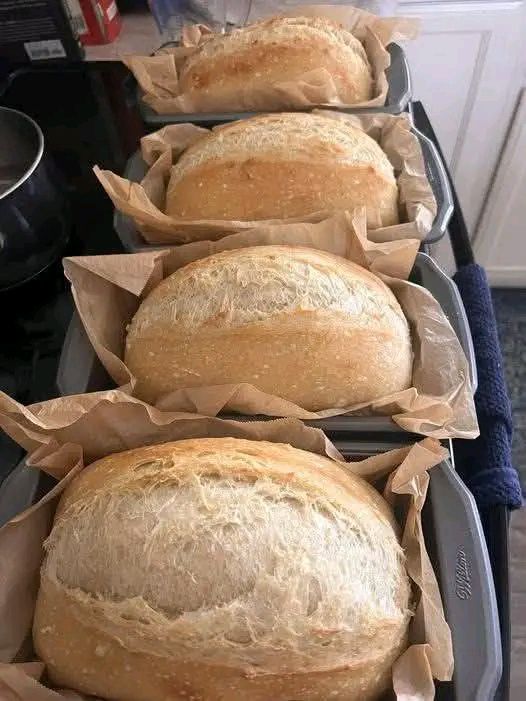
Prep Time: 30 minutes (active)
*Fermentation Time: 24-36 hours*
*Proofing Time: 6-12 hours*
Baking Time: 45 minutes
*Total Time: 30-48 hours*
Difficulty: Advanced
Intensity: Moderate (mostly waiting)
Yields: 1 large loaf (approximately 16 slices)
The Soul of Simplicity: Why Sourdough?
This recipe isn’t just instructions—it’s an invitation to participate in one of humanity’s oldest culinary traditions. Unlike commercial yeast breads, sourdough relies on wild yeast and lactic acid bacteria cultivated in your own kitchen. The extended fermentation creates complex flavors, improves digestibility, and develops a spectacular crust and crumb. While the timeline appears daunting, remember that 95% of the process is passive fermentation. Your active involvement totals about 45 minutes spread over two days.
Ingredients
For the Levain (Starter)
50g mature sourdough starter (100% hydration)
50g bread flour
50g whole wheat flour
100g filtered water (room temperature)
For the Main Dough
350g bread flour (high-protein, 12-14% protein preferred)
150g whole wheat flour
375g filtered water (75°F/24°C)
10g fine sea salt
200g active levain (from above)
Special Equipment
Digital kitchen scale (essential for accuracy)
Dutch oven or combo cooker
Bread lame or very sharp razor blade
Proofing basket (banneton) or bowl lined with tea towel
Dough scraper
The Process: A Timeline of Transformation
Day 1: Morning (8:00 AM) – Create Your Levain
Mix Levain (5 minutes): In a small jar or bowl, combine all levain ingredients. Stir vigorously until no dry flour remains. The mixture should resemble thick pancake batter.
Ferment (6-8 hours): Cover loosely and let sit at room temperature (70-75°F/21-24°C ideal). Your levain is ready when it has doubled in volume, is bubbly throughout, and passes the float test (a small spoonful floats in water).
Day 1: Afternoon (2:00-4:00 PM) – Mix and Autolyse
Intensity: Low | Active Time: 20 minutes
Autolyse (30 minutes resting included): In a large mixing bowl, combine both flours and 350g of the water (reserving 25g). Mix until no dry flour remains. Let this shaggy mass rest for 30 minutes. This hydrates the flour and begins gluten development without salt interference.
Incorporate Levain and Salt (10 minutes): Add the 200g of active levain to the dough. Use wet hands to pinch and fold until fully incorporated. Rest 10 minutes. Add the salt with the reserved 25g water, again mixing thoroughly.
Bulk Fermentation Begins (6-8 hours): Cover the bowl with a damp towel or plastic wrap. You’ll perform stretch-and-folds during this period.
Day 1: Evening – Stretch and Fold Series
Intensity: Low | Active Time: 10 minutes total
During bulk fermentation, perform 4 sets of stretch-and-folds at 30-minute intervals:
Wet your hands, grab one side of the dough, stretch it upward, and fold it over the center.
Rotate the bowl 90 degrees and repeat until you’ve gone around the dough (4-6 folds total).
This develops gluten strength without kneading. After the fourth fold, let the dough rest undisturbed for the remainder of bulk fermentation. The dough should increase 30-50% in volume, be bubbly, and jiggle when shaken.
Day 1: Night (10:00 PM-Midnight) – Shape and Cold Proof
Intensity: Moderate | Active Time: 15 minutes
Pre-Shape (5 minutes): Gently turn the dough onto a lightly floured surface. Using a dough scraper, fold the edges toward the center, creating surface tension. Let rest 20 minutes (bench rest).
Final Shape (10 minutes): Dust your proofing basket generously with rice flour (prevents sticking). Flip the dough so the smooth side is down. Fold the bottom third up, sides toward the center, then roll from bottom to top, sealing the seam. Place seam-side up in the basket.
Cold Proof (12-16 hours): Cover the basket with a plastic bag and refrigerate immediately. This slow fermentation deepens flavor and improves oven spring.
Day 2: Morning/Afternoon – Bake
Intensity: Moderate | Active Time: 45 minutes
Preheat (30 minutes before baking): Place your Dutch oven (with lid) in the oven and preheat to 500°F (260°C). The pot needs at least 30 minutes to fully heat.
Score and Bake (5 minutes active): Carefully remove the hot Dutch oven. Turn your proofed dough onto parchment paper. Using your lame, make one confident slash about ½-inch deep at a 45-degree angle. This controls expansion.
The Bake:
Steam Phase (20 minutes): Lower the dough (with parchment) into the Dutch oven. Cover with lid and bake at 500°F (260°C) for 20 minutes. The steam creates a crisp crust.
Dry Phase (25 minutes): Reduce temperature to 450°F (230°C). Remove the lid. The bread should be pale but set. Continue baking until deep golden brown, about 25 minutes.
Cool (2+ hours, critical!): Transfer to a wire rack. Wait at least 2 hours before slicing. The bread continues to set internally during this time.
The Reward: Nutrition & Serving
Nutrition Information Per Slice (1/16 of loaf):
Calories: 145
Total Fat: 0.6g
Saturated Fat: 0.1g
Sodium: 243mg
Total Carbohydrates: 30g
Dietary Fiber: 2g
Sugars: 0.2g
Protein: 5g