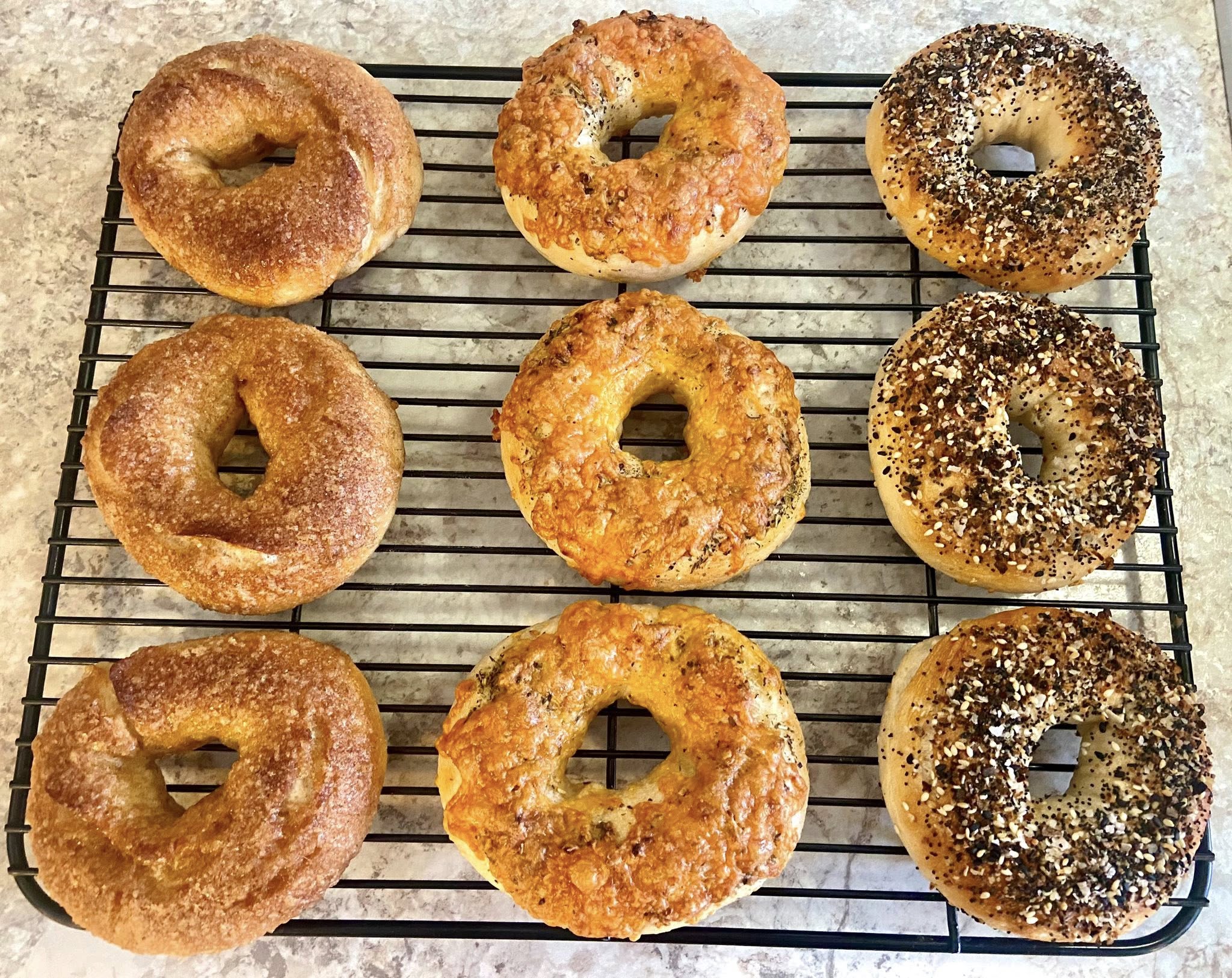
Prep Time: 30 minutes (plus 12-18 hours fermentation)
Cook Time: 25 minutes
Total Time: 13-19 hours (mostly hands-off)
Difficulty: Medium (Requires an active sourdough starter and some shaping practice)
Yield: 8 generous bagels
Ingredients
For the Bagel Dough:
150g (⅔ cup) active, bubbly sourdough starter (100% hydration)
500g (about 4 cups + 2 tbsp) bread flour (high-protein flour is ideal)
270g (1 cup + 2 tbsp) lukewarm water
25g (2 tbsp) barley malt syrup or honey
10g (1 ¾ tsp) fine sea salt
Neutral oil (like avocado or vegetable), for greasing
For the Poaching Liquid:
2 quarts (8 cups) water
30g (2 tbsp) barley malt syrup or honey
1 tbsp baking soda
1 tbsp fine sea salt
For Topping (Optional):
Everything Bagel Seasoning, sesame seeds, poppy seeds, dried onion flakes, or coarse sea salt.
Equipment You’ll Need
Stand mixer with dough hook (optional, but helpful)
Large mixing bowl
Kitchen scale (highly recommended for accuracy)
Dough scraper
Slotted spoon or spider strainer
Large pot
Parchment paper
Two baking sheets
Wire cooling rack
Step-by-Step Instructions
Day 1: Evening – Mix & Bulk Fermentation
Feed Your Starter: Ensure your sourdough starter is active, bubbly, and has been fed 4-8 hours before you plan to mix the dough.
Mix the Dough: In the bowl of a stand mixer or a large mixing bowl, combine the active starter, lukewarm water, and barley malt syrup. Mix briefly to disperse. Add all the bread flour and salt.
Knead: Using the dough hook on low speed (or by hand with a sturdy spoon and later your hands), mix until a shaggy dough forms. Increase speed to medium and knead for 8-10 minutes. The dough should be very stiff, smooth, and slightly tacky but not sticky. It will feel denser than typical bread dough—this is correct.
Bulk Fermentation: Lightly grease a clean bowl. Form the dough into a ball, place it in the bowl, and cover with a damp cloth or airtight lid. Let it ferment at room temperature (70-75°F / 21-24°C) for 2 hours.
Cold Ferment: After 2 hours, perform a set of stretches and folds: gently lift one side of the dough and fold it toward the center. Rotate the bowl and repeat 3-4 times until you’ve gone around the dough. Re-cover the bowl and place it directly in the refrigerator for a long, slow cold fermentation for 12-16 hours.
Day 2: Morning – Shape, Proof & Boil
Divide the Dough: Line two baking sheets with parchment paper. Lightly dust a work surface with flour. Turn the cold dough out onto it and divide it into 8 equal pieces (use a scale for accuracy—each piece should be ~115-120g).
Pre-Shape: Roll each piece into a tight, smooth ball. Cover with a damp towel and let rest for 15-20 minutes. This relaxes the gluten for shaping.
Shape the Bagels: To shape using the traditional “poke-through” method: Flatten a ball slightly. Using your thumbs, poke a hole through the center. Gently stretch and rotate the dough around your fingers to widen the hole to about 2 inches in diameter (it will shrink back). Place each shaped bagel on the prepared baking sheet, spacing them about 2 inches apart.
Final Proof: Cover the shaped bagels loosely with a clean, damp kitchen towel or plastic wrap. Let them proof at room temperature for 1 to 1.5 hours. They won’t double in size but will look slightly puffed. Perform the “float test”: gently drop a bagel into a glass of room-temperature water. If it floats within 10 seconds, it’s ready to boil. If it sinks, let it proof a little longer and test again.
Preheat & Prep: While the bagels proof, preheat your oven to 425°F (220°C). Bring the 2 quarts of water for poaching to a boil in a wide pot. Add the malt syrup, baking soda, and salt. Reduce to a gentle simmer.
Boil & Bake
Poach the Bagels: Carefully lower 2-3 bagels at a time into the simmering poaching liquid using a slotted spoon. Poach for 45 seconds per side. The baking soda in the water is the secret to that classic shiny, chewy crust.
Add Toppings: Immediately after poaching, while the bagels are still wet, sprinkle heavily with your chosen toppings (if using). Return them to the parchment-lined baking sheet.
Bake: Bake the bagels in your preheated oven for 20-25 minutes, rotating the pans halfway through, until they are deeply golden brown and crisp.
Cool: Transfer the baked bagels to a wire cooling rack. This is crucial! You must let them cool for at least 30 minutes before slicing. This allows the crumb to set and prevents a gummy texture.
Storage & Serving
Serve: Slice, toast, and slather with cream cheese, butter, or your favorite spread.
Store: Keep in a paper bag for up to 2 days for best crust texture. For longer storage, place in a plastic bag at room temperature for up to 4 days.
Freeze: For optimal freshness, freeze unsliced bagels in a single layer on a baking sheet, then transfer to a freezer bag for up to 3 months. Thaw at room temperature or toast directly from frozen.
Baker’s Notes & Tips
Starter Vitality: A strong, active starter is non-negotiable for proper rise and flavor. If your starter is sluggish, your bagels will be dense.
Flour Power: Bread flour’s higher protein content (12-13%) is essential for developing the strong gluten network needed for the iconic chewy texture.
The Float Test is Your Friend: Don’t skip it! It’s the most reliable way to know your bagels are perfectly proofed and ready for the boil.
Boiling is Key: Poaching sets the crust, gives the bagel its shine, and contributes to the interior texture. A simmer (not a rolling boil) is perfect.
Nutrition Information (per 1 plain bagel)
Calories: ~290 kcal
Total Fat: 1g
Saturated Fat: 0g
Cholesterol: 0mg
Sodium: 580mg*
Total Carbohydrates: 60g
Dietary Fiber: 2g
Sugars: 3g
Protein: 10g