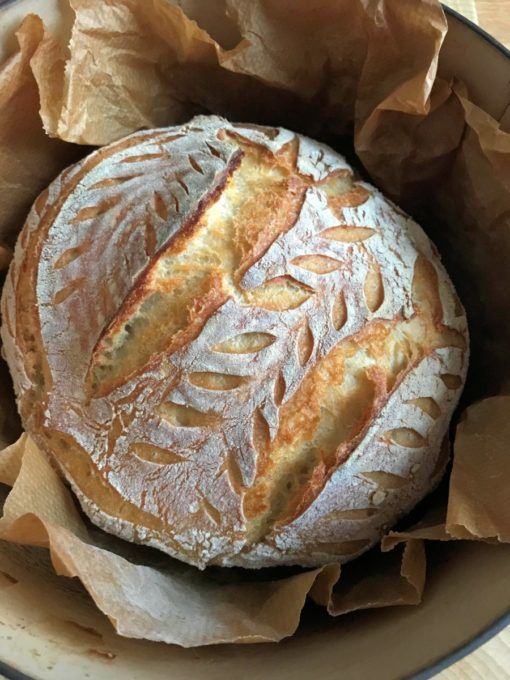
Prep Time: 30 minutes (active)
Cook Time: 45 minutes
Total Time: ~24-36 hours (including fermentation and proofing)
Recipe Intensity: Medium-High (Requires planning and patience, but techniques are straightforward)
Yield: 1 beautiful round loaf (boule)
Ingredients
-
500g (about 4 cups + 2 tbsp) Bread Flour (high-protein, such as King Arthur)
-
350g (1 ½ cups) Water (lukewarm, ~85°F/30°C)
-
100g (½ cup) Active, Bubbly Sourdough Starter (fed 4-12 hours prior)
-
10g (2 tsp) Fine Sea Salt
-
Optional: Rice flour for dusting the banneton
Equipment
-
Digital kitchen scale (highly recommended for accuracy)
-
Large mixing bowl
-
Bench scraper
-
Banneton (proofing basket) or a medium bowl lined with a well-floured tea towel
-
Dutch oven with lid
-
Razor blade or sharp lame for scoring
-
Parchment paper
Instructions
Day 1: Morning (or the night before)
1. Feed Your Starter: Ensure your sourdough starter is active, bubbly, and has peaked or is just past its peak. This is crucial for a strong rise. If your starter lives in the fridge, feed it 1-2 times at room temperature until it’s vigorously active.
Step 1: Autolyse (Rest Time: 1 hour | Intensity: Low)
In a large bowl, combine the 500g bread flour and 350g water. Mix with your hands or a spatula until no dry flour remains. It will be a shaggy mass. Cover the bowl and let it rest for 1 hour. This allows the flour to fully hydrate, developing gluten structure with minimal effort.
Step 2: Mix & Bulk Fermentation (Active Time: 15 mins | Rest Time: 4-6 hours | Intensity: Medium)
-
To the autolysed dough, add the 100g active starter and 10g salt. Use wet hands to pinch and fold the ingredients until fully incorporated. The dough will be sticky and slack.
-
Stretch and Folds: Over the next 2-3 hours, perform 4-6 sets of “stretch and folds,” spaced 30 minutes apart. With wet hands, grab one side of the dough, stretch it up, and fold it over the center. Repeat around the bowl (usually 4-6 folds per set). This builds strength without traditional kneading.
-
Rest: After the final set, cover the bowl and let the dough finish its bulk fermentation at room temperature (70-75°F / 21-24°C is ideal). It should look puffy, have bubbles along the sides, and have increased in volume by about 50%. This can take 3-5 more hours, depending on your kitchen’s temperature. Total bulk fermentation is typically 5-8 hours.
Step 3: Shape & Cold Proof (Active Time: 10 mins | Rest Time: 12-16 hours | Intensity: Medium)
-
Lightly flour your work surface. Gently turn the dough out. Using a bench scraper, shape it into a loose round. Let it rest, uncovered, for 20-30 minutes (this is the bench rest).
-
For the final shape: lightly flour the top of the dough. Using your bench scraper, flip it over so the floured side is down. Gently stretch the edges and fold them into the center, creating surface tension. Flip the dough seam-side down and, using the scraper and your other hand in a “cupping” motion, drag it towards you to tighten the surface into a smooth boule.
-
Generously dust a banneton or towel-lined bowl with a 50/50 mix of rice and all-purpose flour. Place the dough seam-side up in the basket. Cover with a reusable bag or damp tea towel.
The Last Step: The Long Cold Ferment
Place the entire banneton into the refrigerator for 12-16 hours (overnight). This “retardation” develops complex sour flavor, improves oven spring, and makes the dough easier to score.
Day 2: Bake Day
Step 4: Preheat & Score (Active Time: 15 mins | Intensity: Medium)
-
Place your Dutch oven (with lid on) in your oven and preheat to 500°F (260°C) for at least 45 minutes.
-
Take your banneton from the fridge. Place a sheet of parchment paper over the top and invert the dough onto it. The dough should hold its shape.
-
Using a razor blade or lame, score the top with one confident, swift cut about ¼-inch deep. A simple single slash or an “X” works perfectly. This controls where the bread expands (the “oven spring”) in the heat.
Step 5: Bake (Time: 45 mins | Intensity: Low)
-
Carefully remove the hot Dutch oven. Using the parchment as a sling, lower the dough into the pot. Cover with the lid.
-
Bake covered for 20 minutes. This creates a steamy environment for maximum spring and a glossy crust.
-
Reduce the oven temperature to 450°F (230°C). Remove the lid. The loaf will be pale and puffed.
-
Bake uncovered for 20-25 minutes more, until the crust is a deep, burnished amber brown and sounds hollow when tapped on the bottom.
-
Transfer the loaf to a wire cooling rack. This is critical: let the bread cool completely for at least 3-4 hours before slicing. The interior is still setting; cutting too soon will result in a gummy crumb.
Nutrition & Serving Information
Serving Size: 1 slice (approx. 1/12th of the loaf)
Calories: ~150
Total Fat: 0.5g
Saturated Fat: 0g
Cholesterol: 0mg
Sodium: 325mg
Total Carbohydrates: 31g
Dietary Fiber: 1g
Sugars: 0g
Protein: 5g