Active Time: 30 minutes
Inactive/Rest Time: 8–12 hours (overnight bulk fermentation) + 3–4 hours (final proof)
Total Time: ~12–16 hours
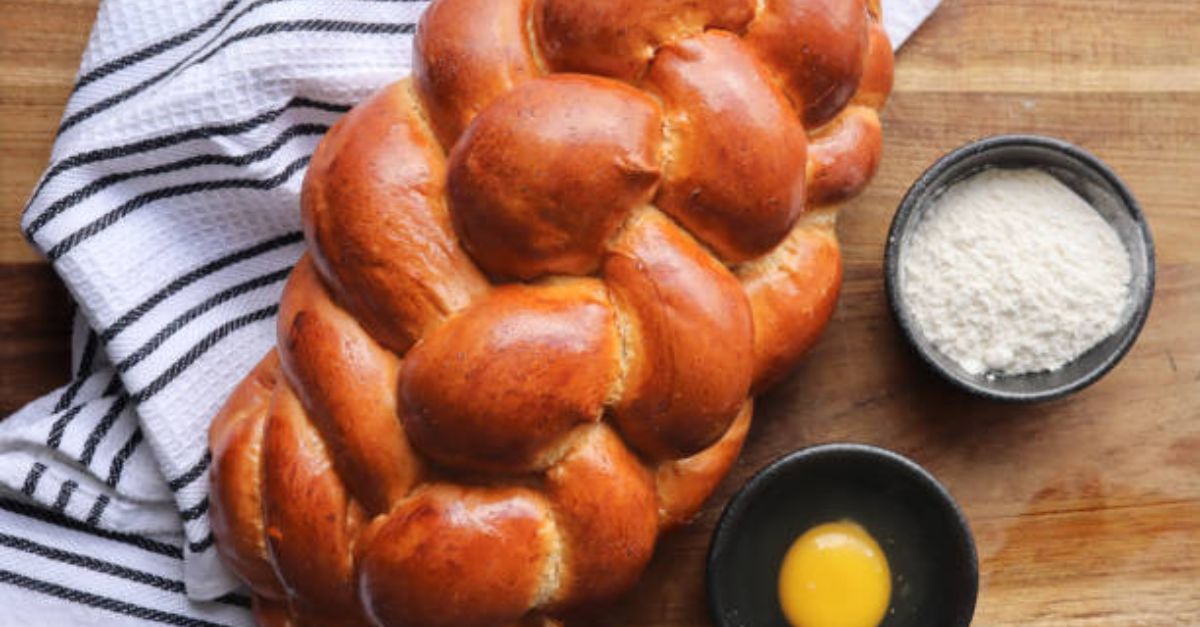
This Sourdough Challah strikes the perfect balance between the rich, eggy softness of traditional Jewish challah and the complex, tangy crumb of naturally leavened bread. The long fermentation makes it more digestible than yeasted versions, while the golden braid delivers showstopping beauty. Perfect for Shabbat, Sunday brunch, or French toast that will change your life.
Why This Recipe Works
No commercial yeast – All rise comes from your active sourdough starter.
Rich & tender – Eggs and oil create a plush, brioche-like crumb.
Deep flavor – Slow cold or room-temp fermentation develops nutty, tangy notes.
Beautiful braid – Holds its shape without collapsing.
Ingredients
For the Dough (makes 1 large loaf, ~900g)
Ingredient Weight Volume (US)
Active sourdough starter (100% hydration, fed & bubbly) 150g ~½ cup + 1 tbsp
Bread flour (or all-purpose) 500g 4 cups
Large eggs (room temp) 2 2
Egg yolk (room temp) 1 1
Water (lukewarm, 80°F/27°C) 180g ¾ cup
Honey or maple syrup 50g 2½ tbsp
Vegetable or avocado oil 60g ¼ cup
Fine sea salt 10g 1½ tsp
For the Egg Wash
Ingredient Amount
Egg yolk 1
Water or milk 1 tsp
Pinch of salt 1 pinch
Optional Toppings
Poppy seeds, sesame seeds, or everything bagel seasoning
Equipment Needed
Large mixing bowl
Bench scraper
Stand mixer with dough hook (optional, but helpful)
9×5 inch loaf pan (optional – free-form braid works too)
Parchment paper
Baking sheet
Instant-read thermometer
Pastry brush
Timeline at a Glance
Time Task
8:00 PM (night before) Feed starter.
8:00 AM (next morning) Mix dough.
8:30 AM – 6:30 PM Bulk ferment (4–6 hours at 72°F, or 10–12 hours in fridge).
6:30 PM Shape & braid.
7:00 PM – 10:00 PM Final proof (2–3 hours).
10:00 PM Bake.
10:45 PM Cool & serve.
Step-by-Step Instructions
1. Feed Your Starter (Night Before or Morning Of)
Ensure your sourdough starter is active and bubbly. Feed it 1:1:1 (starter:flour:water) 6–12 hours before mixing. It should have doubled in volume and pass the float test (a small spoonful floats in room-temp water).
2. Mix the Dough (10 minutes active)
In a large bowl, whisk together the lukewarm water, honey, and active starter until milky. Add both whole eggs plus the extra yolk, and the oil. Whisk to combine.
Add the bread flour and salt. Mix with a wooden spoon or dough hook until a shaggy, sticky dough forms. No dry flour should remain.
3. Knead & Develop Gluten (10–15 minutes)
By hand: Turn dough onto an unfloured counter. Slap and fold for 10–12 minutes until smooth and elastic. It will be sticky but should release from the counter with a bench scraper.
By mixer: Use dough hook on medium-low for 8–10 minutes. Dough should clear the sides but remain slightly tacky at the bottom.
Test for windowpane: Stretch a small piece thin. It should become translucent without tearing.
4. Bulk Fermentation (4–6 hours at 72°F / 22°C)
Place dough in a lightly oiled bowl. Cover with a damp towel or plastic wrap.
Stretch and fold every 30 minutes for the first 2 hours (4 total sets). This builds strength without aggressive kneading:
Wet your hands. Grab one side of the dough, stretch it up, and fold it over the center.
Rotate bowl 90°, repeat 4–5 times.
After the last fold, let dough rest undisturbed for the remaining 2–4 hours. It should become puffy, show small bubbles on top, and increase by about 50% (not double – challah is enriched, so it rises slower).
Cold ferment option: After folds, refrigerate dough for 8–12 hours. Bring back to room temp (2–3 hours) before shaping.
5. Shape & Braid (15 minutes)
Lightly flour your counter. Turn out dough and divide into 3 or 6 equal pieces (for 3-strand or 6-strand braid).
For a 3-strand braid (easiest):
Roll each piece into a 14-inch rope, slightly tapered at ends.
Pinch the three tops together.
Cross the right rope over the middle.
Cross the left rope over the new middle.
Repeat until braided. Pinch the bottom ends together.
Tuck both pinched ends under the loaf.
Place braid on a parchment-lined baking sheet (or into a greased loaf pan for a tighter shape).
6. Final Proof (2–3 hours at 75°F / 24°C)
Cover loosely with plastic (sprayed with oil to prevent sticking). Let rise until noticeably puffy and nearly doubled. Test: Gently poke the dough. It should slowly spring back, leaving a small indentation.
Do not overproof – enriched sourdough can collapse.
7. Egg Wash & Topping (5 minutes)
Preheat oven to 375°F (190°C) with rack in the middle.
Whisk egg yolk, 1 tsp water, and salt. Gently brush over the entire braid (avoid letting it pool in crevices). Sprinkle with seeds if desired.
8. Bake (30–35 minutes)
Place baking sheet on middle rack. Bake for 25 minutes, then rotate. Continue baking 5–10 minutes more until deep golden brown and internal temperature reaches 190–200°F (88–93°C).
If browning too fast, tent loosely with foil after 20 minutes.
9. Cool (Critical – 1 hour minimum)
Transfer to a wire rack. Do not slice hot – the crumb needs to set. Cool completely (at least 1 hour) for clean slices.
Troubleshooting
Problem Likely Cause Fix
Dense, gummy crumb Underproofed final rise Add 30–60 minutes to final proof.
Flat braid Overproofed or weak starter Reduce final proof time; strengthen starter.
Too dark crust Oven too hot Lower to 350°F (175°C) next time.
Dry interior Overbaked Check temp at 30 minutes; remove at 195°F.
Storage & Serving
Room temp: Wrap tightly and keep 3 days.
Fridge: 1 week (toast before eating).
Freezer: Slice and freeze up to 3 months.
Best uses: French toast, bread pudding, challah stuffing, or slathered with butter.
Nutrition Information
*Per serving (1/12 of loaf, ~75g)*
Nutrient Amount
Calories 265 kcal
Protein 7g
Carbohydrates 38g
Fiber 1.5g
Sugars 5g
Fat 9g
Saturated Fat 1.5g
Cholesterol 55mg
Sodium 290mg
Potassium 70mg
Iron 2.1mg (12% DV)
Calcium 20mg (2% DV)