Total Time: 18-24 hours (mostly hands-off fermentation)
Active Time: ~1.5 hours
Difficulty: Advanced
Yield: 1 spectacular loaf
A Culinary Hybrid For The Bold Baker
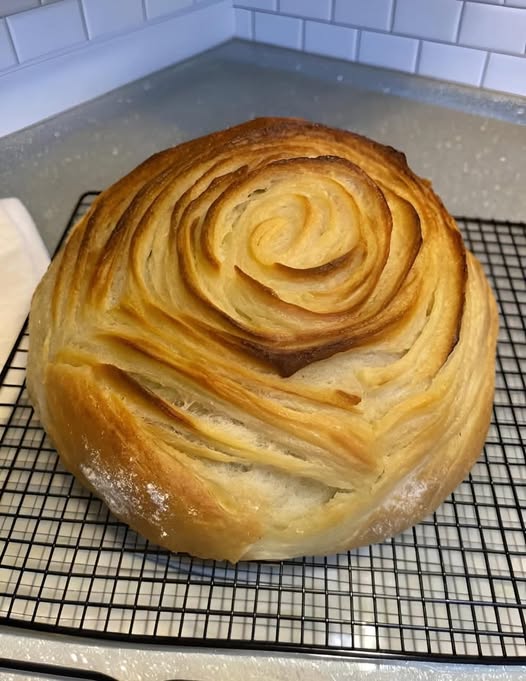
This Croissant Sourdough Loaf is where French patisserie meets rustic artisan baking. Imagine the shattering, buttery flakiness of a classic croissant, woven into the tangy, chewy crumb and blistered crust of a sourdough boule. It’s a project bake for a weekend, demanding patience and technique, but rewarding you with a showstopping loaf that’s perfect for a luxurious weekend brunch, unforgettable toast, or simply eaten slice by slice, savoring the marriage of two baking worlds.
Ingredients
For the Sourdough Levain (Prepare 8-12 hours before mixing dough)
40g mature, active sourdough starter (100% hydration)
40g bread flour
40g whole wheat flour
80g warm water
For the Main Dough
All of the levain (200g)
500g bread flour (high-protein, ~12-13%)
300g cold water
11g fine sea salt
20g granulated sugar
For the Butter Block & Lamination
250g unsalted, European-style butter (82-84% fat), cold
25g bread flour (for dusting during folds)
Equipment
Stand mixer with dough hook (optional, can mix by hand)
Rolling pin
Parchment paper
Plastic wrap
Bench scraper
Sharp razor blade or lame
Dutch oven (for baking)
Pastry brush
Step-by-Step Instructions
Day 1: Evening – Create the Levain
Time: 5 minutes active
Mix the 40g active starter with 80g warm water until dissolved.
Add the 40g bread flour and 40g whole wheat flour. Stir until no dry bits remain.
Cover and let ferment at room temperature (70-75°F / 21-24°C) for 8-12 hours, or until it is at least doubled in size, bubbly, and passes the float test (a small spoonful floats in water).
Day 2: Morning – Mix & Bulk Ferment
Active Time: 25 minutes | Rest Time: 4-5 hours
Autolyse: In the bowl of a stand mixer, combine 500g bread flour and 300g cold water. Mix until just combined and no dry flour remains. Cover and let rest for 1 hour. This allows the flour to fully hydrate and gluten to develop passively.
Mix the Dough: Add the ripe levain, 11g salt, and 20g sugar to the autolysed dough. Mix on low speed with the dough hook for 3-4 minutes until fully incorporated, then increase to medium speed for 6-8 minutes. The dough should clear the sides of the bowl, be smooth, and pass the windowpane test (you can stretch a small piece thinly enough to see light through it without tearing). Target dough temperature: 75-78°F (24-26°C).
Shape & Chill: Gently shape the dough into a smooth ball. Place it seam-side down in a lightly oiled bowl, cover tightly, and let rest at room temperature for 30 minutes.
Coil Folds: Perform a series of 3-4 “coil folds” at 30-minute intervals. To coil fold, wet your hands, reach under one side of the dough, stretch it upward, and fold it over the center. Repeat on all four sides. This builds strength without degassing the dough.
Final Bulk: After the last fold, cover the bowl and let the dough finish its bulk fermentation. It should look puffy, have increased by about 30-50%, and be full of gas bubbles. This may take 2-3 more hours, depending on your kitchen temperature.
Pre-shape & Chill: Gently turn the dough onto a lightly floured surface. Shape it into a rough rectangle. Wrap tightly in plastic wrap and refrigerate for at least 2 hours, or up to overnight. The dough must be very cold (around 40°F / 4°C) for lamination.
Day 2: Afternoon – Laminate the Dough
Active Time: 45 minutes | Rest Time: 2+ hours
Prepare Butter Block: While dough chills, place 250g cold butter between two sheets of parchment paper. Pound with a rolling pin into a pliable, cool (not warm or greasy) 7×7-inch square. Refrigerate until needed.
First Lock-In: On a lightly floured surface, roll your cold dough into a 10×10-inch square. Place the butter block in the center like a diamond (points facing the sides of the dough square). Fold the corners of the dough over the butter to meet in the center, pinching the seams to seal completely. You now have a butter parcel.
First Turn: With the seam side down, gently roll the parcel into a long rectangle, about 8×24 inches. Use firm, even pressure. Perform a book fold: fold the bottom third up and the top third down, like closing a book. Wrap and chill for 1 hour.
Second Turn: Place the dough with the open “spine” of the book fold to your left. Roll it out again to an 8×24-inch rectangle. Perform a simple fold (letter fold): fold the bottom third up and the top third over. Wrap and chill for 1 hour.
Final Shaping: Roll the laminated dough into a large rectangle, about 10×15 inches. Starting from a short end, roll the dough up tightly into a log, like a jelly roll. Place the log seam-side down into a parchment-lined 9×5-inch loaf pan. Cover lightly with plastic.
Final Proof: Let the loaf proof at a cool room temperature (70-72°F / 21-22°C) for 2-3 hours, until it has risen just to the rim of the pan. It should feel light and airy, but still cool to the touch. Do not over-proof, or the butter will melt and leak. Alternatively, proof in the refrigerator for 8-12 hours and bake straight from the fridge.
Day 2: Evening – Bake
Active Time: 10 minutes | Bake Time: 50 minutes
Preheat your oven and Dutch oven to 450°F (230°C) for at least 45 minutes.
Score: Carefully transfer the proofed loaf (still on its parchment) to the preheated Dutch oven. Using a sharp razor, make one long, deep slash down the center of the loaf.
Bake: Cover and bake for 20 minutes. Reduce heat to 400°F (200°C), remove the lid, and bake for another 25-30 minutes until the loaf is a deep, glossy golden brown and an internal thermometer reads at least 205°F (96°C).
Cool: This is the hardest part. Let the loaf cool completely on a wire rack for at least 4 hours, ideally overnight. The structure is still setting, and cutting too soon will release steam and make the layers gummy.
Nutrition Information
*Per serving (1 slice, approx. 1/12th of loaf)*
Calories: ~320 kcal
Total Fat: 18g
Saturated Fat: 11g
Cholesterol: 45mg
Sodium: 320mg
Total Carbohydrates: 34g
Dietary Fiber: 1g
Sugars: 2g
Protein: 5g