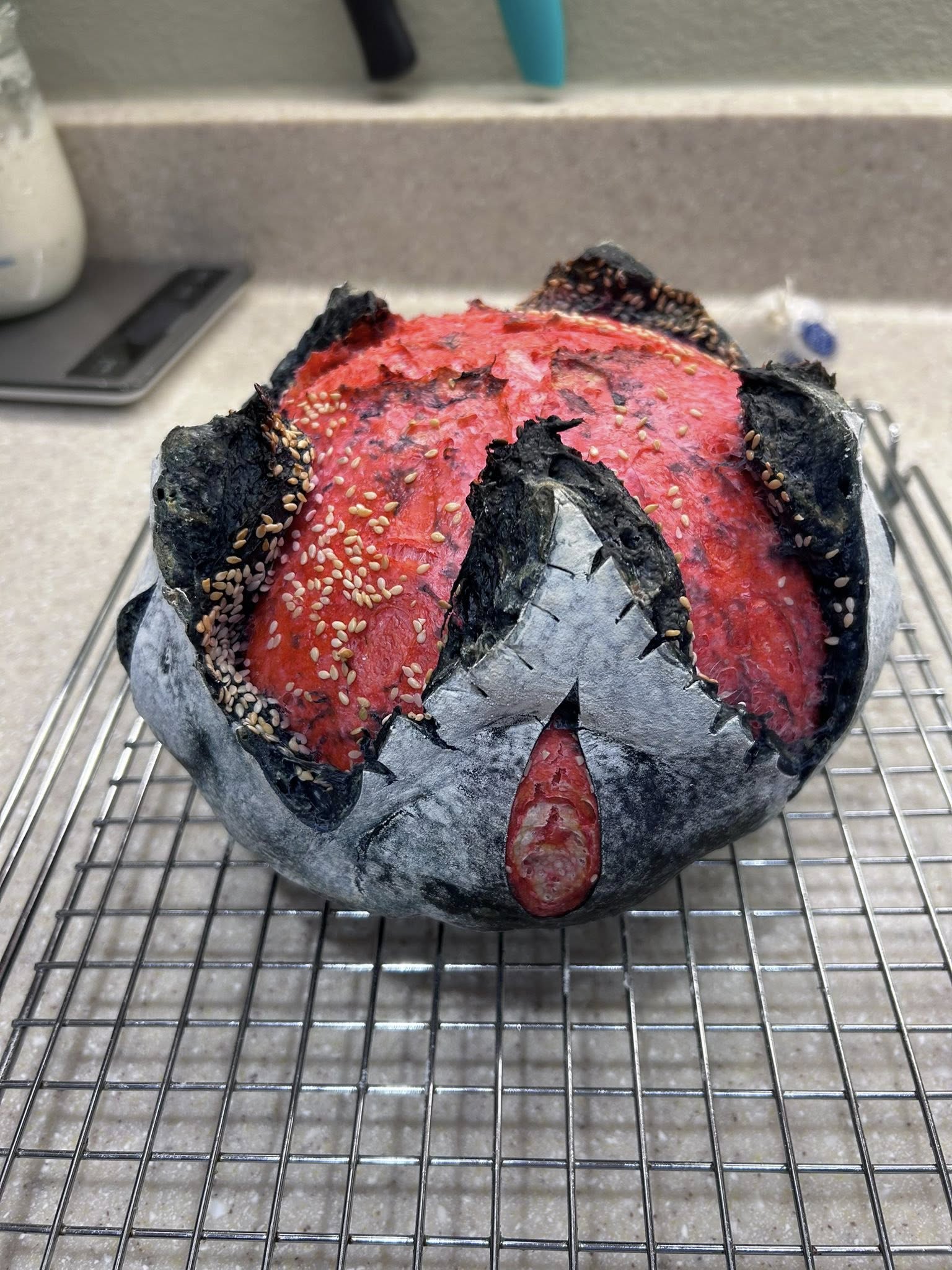
Active Time: 40 minutes | Total Time: 24-36 hours (including fermentation) | Intensity: Intermediate (For the dedicated home baker, like the Party solving a mystery) | Yields: 1 Demogorgon-sized Loaf
This isn’t just sourdough. This is a recipe that draws its flavor from a long, slow fermentation in our dimension (your kitchen), developing a depth of character as intriguing as the plot of Hawkins’ favorite show. The crust crackles with satisfying darkness, and the interior reveals a tender, open crumb, glowing with holes like tiny gateways to another world. It requires patience and a bit of science, but the result—a loaf worthy of Joyce Byers’ frantic energy and Hopper’s steadfast reliability—is utterly worth it. Consider it your culinary “Sensory Deprivation Tank” project.
Ingredients: The Essentials
For the Levain (Your Starter’s “Episode One”):
50g active, bubbly sourdough starter (at 100% hydration)
50g bread flour
50g whole wheat flour (for extra complexity)
100g lukewarm water
For the Main Dough (The Main Cast):
350g bread flour (high-protein, 12-13%)
100g whole wheat flour
325g lukewarm water (about 85°F/29°C)
9g fine sea salt (the “salt” in “salt bath”)
All of the levain (from above)
Rice flour, for dusting (it won’t stick, like a good plan)
Equipment:
Digital scale (non-negotiable for precision)
Medium mixing bowl
Bench scraper
Banneton (proofing basket) or a colander lined with a well-floured tea towel
Dutch oven with lid
Razor blade or sharp lame for scoring
Method: The Timeline to a Parallel Dimension of Flavor
Chapter 1: Activate the Portal (Levain Build) – 6-8 hours before mixing dough
In a small jar or bowl, mix the 50g starter with the flours and water for the levain until no dry bits remain. Cover loosely and let it ferment at room temperature. It’s ready when it’s at least doubled in size, billowy, and passes the “float test” (a small spoonful floats in a glass of water). This is your active gatekeeper.
Chapter 2: Mixing & Autolyse (The Calm Before the Storm) – Day 1, Evening
Autolyse: In your main mixing bowl, combine the 350g bread flour and 100g whole wheat flour with the 325g of lukewarm water. Mix with your hands or a spatula until no dry flour remains—it will be a shaggy, rough mass. Cover the bowl and let it rest for 1 hour. This allows the flour to fully hydrate and gluten to begin developing naturally, making the dough stronger and more elastic.
Incorporate Levain & Salt: After the hour, add the entire ripe levain to the top of the autolysed dough. Use wet hands to pinch and fold the levain into the dough until it’s relatively integrated. It will be messy—that’s okay. Let it rest, covered, for 20 minutes.
Now, sprinkle the 9g of salt evenly over the dough. Add a splash of water (about 1 tsp) to help dissolve it. Again, with wet hands, pinch, fold, and squeeze the dough until the salt is fully incorporated and the dough begins to smooth slightly. This is your official dough mix.
Chapter 3: Bulk Fermentation (The Long, Slow Development) – 4-5 hours
This is where flavor and strength are built. Over the next 4-5 hours at a cozy room temperature (~72°F/22°C), you will perform a series of “coil folds.”
Every 30 minutes for the first 2 hours, perform a set of coil folds: With wet hands, reach under one side of the dough in the bowl, lift it up, and fold it over the center. Rotate the bowl 90 degrees and repeat on all four “sides.” The dough will transform from slack and sticky to strong, smooth, and aerated.
After the folds, let the dough rest, covered, for the remainder of the bulk fermentation. It’s ready when it has increased in volume by about 50-75%, looks puffy and alive, and has a dome-like surface with some visible bubbles.
Chapter 4: Shaping & Cold Proof (A Night in The Void) – 12-16 hours
Shaping: Gently turn the dough out onto a lightly floured surface. Using your bench scraper, shape it into a tight boule (round) or batard (oval). This creates surface tension, the key to a good oven spring.
Proofing: Generously dust your banneton or towel-lined colander with rice flour. Place the dough seam-side up into the basket. This ensures the pretty, smooth side will be the top of your loaf.
Cover the basket with a reusable bag or plastic wrap, and immediately place it in the refrigerator. This long, cold retardation slows fermentation to a crawl, developing incredible sour flavor and making the dough easier to score.
Chapter 5: Baking (Opening the Gate) – Day 2, Next Day
Preheat: Place your Dutch oven (with the lid on) into your oven. Preheat to 500°F (260°C) for at least 45 minutes. Your baking vessel needs to be screaming hot.
Score & Bake: Carefully remove the hot Dutch oven. Take your cold-proofed dough from the fridge and turn it out onto a piece of parchment paper. Score it decisively with your razor blade—a simple central slash or a more elaborate Demogorgon flower pattern (if you dare). Use the parchment as a sling to lower the dough into the scorching pot. Cover with the lid.
Bake Covered: Immediately reduce the oven temperature to 450°F (230°C). Bake with the lid on for 20 minutes. This creates a steamy environment, allowing the loaf to expand maximally (the “oven spring”).
Bake Uncovered: Carefully remove the lid. The loaf will be pale and have sprung. Bake for another 20-25 minutes, uncovered, until the crust is a deep, rich, “Upside-Down” golden brown and sounds hollow when tapped.
Cool (The Hardest Part): Transfer the loaf to a wire cooling rack. You must let it cool completely for at least 3-4 hours. Cutting it too soon releases steam and results in a gummy crumb. This is the true test of patience.
Nutrition & The Last Slice
Per Serving (1/12th of loaf):
Calories: ~185
Total Fat: 0.5g
Sodium: 325mg
Total Carbohydrates: 38g
Dietary Fiber: 2g
Sugars: 0g
Protein: 6g