Total Time: Approximately 18-22 hours (including fermentation)
Active Time: 30-40 minutes
Difficulty: Intermediate
Intensity: Moderate (requires some baking experience, particularly with sourdough)
Yields: 1 loaf (approximately 12-14 slices)
Prep Time: 20 minutes active, 12-16 hours fermentation
Bake Time: 45-55 minutes
Cool Time: 2 hours minimum
Introduction
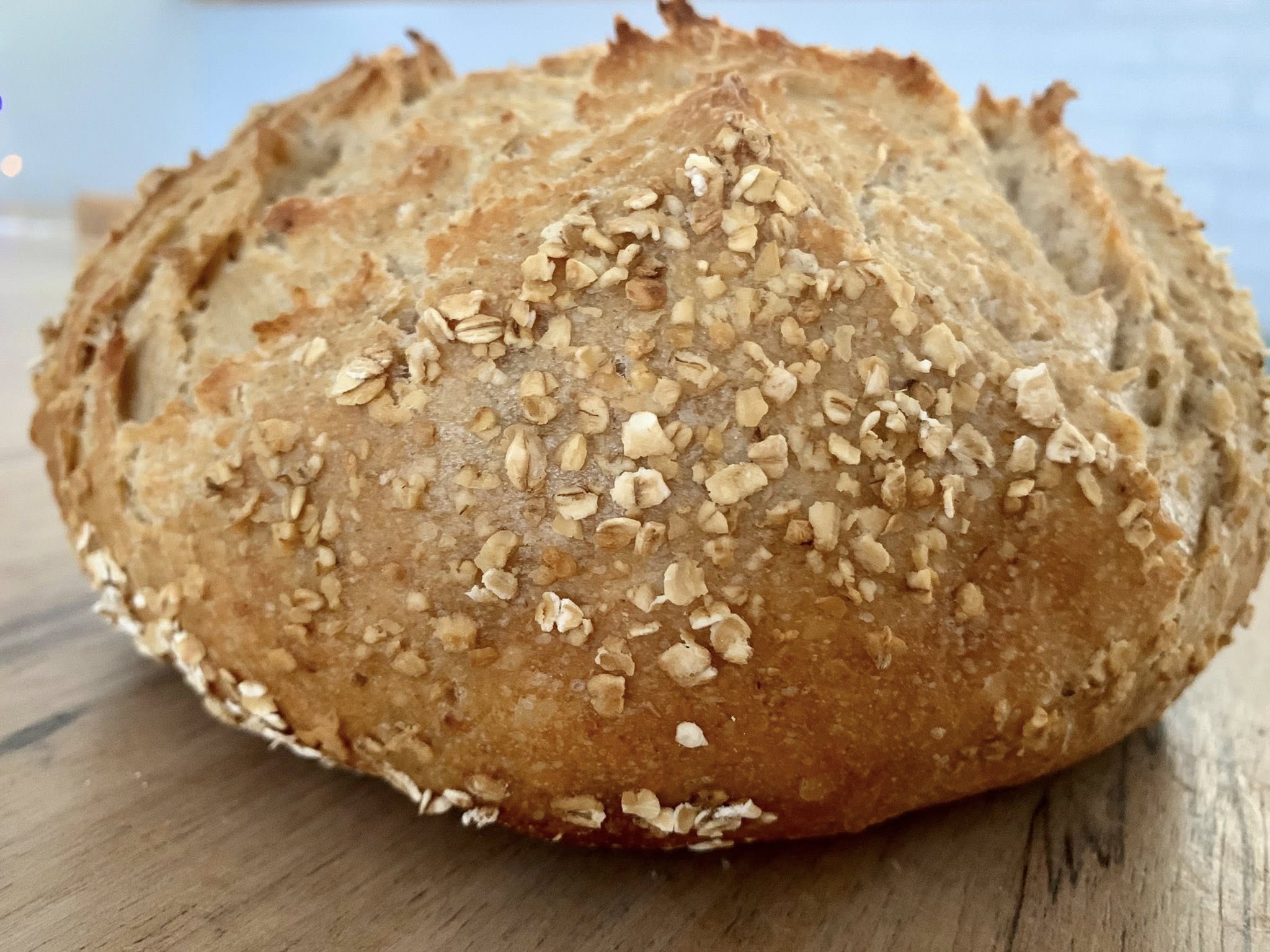
This Oatmeal Sourdough recipe combines the tangy complexity of a traditional sourdough with the comforting, nutty wholesomeness of oats. The result is a beautifully textured loaf with a crisp crust and soft, moist crumb that’s perfect for everything from morning toast to hearty sandwiches. The oats add a subtle sweetness and help retain moisture, making this bread stay fresh longer than many sourdough varieties.
Ingredients
Levain (Overnight Starter)
50g active sourdough starter (100% hydration)
50g bread flour
50g whole wheat flour
100g lukewarm water (75-80°F)
Main Dough
All of the levain (from above)
300g bread flour
100g whole wheat flour
100g old-fashioned rolled oats (plus extra for topping)
350g lukewarm water (divided)
10g fine sea salt
15g honey or maple syrup (optional, enhances browning)
Soaker (Prepare 1 hour before mixing dough)
50g old-fashioned rolled oats
100g boiling water
Equipment
Kitchen scale (highly recommended for accuracy)
Large mixing bowl
Bench scraper
Banneton or bowl lined with towel for proofing
Dutch oven or heavy baking pot with lid
Parchment paper
Spray bottle with water
Instructions
Day 1: Evening (8-10 PM)
1. Prepare the Levain:
In a small bowl, mix 50g active sourdough starter with 50g bread flour, 50g whole wheat flour, and 100g lukewarm water until well combined.
Cover loosely and let ferment at room temperature (68-72°F) for 10-12 hours, or until bubbly, aromatic, and roughly doubled in volume.
Day 2: Morning (8-9 AM)
2. Prepare the Oat Soaker:
One hour before mixing your dough, combine 50g rolled oats with 100g boiling water in a small bowl.
Stir, cover, and let sit to soften and cool to room temperature.
3. Autolyse the Main Dough:
In a large mixing bowl, combine 300g bread flour, 100g whole wheat flour, and 100g rolled oats.
Add 250g of the lukewarm water (reserving 100g for later) and mix until no dry flour remains. The dough will be shaggy.
Cover and let rest for 1 hour. This autolyse allows the flours to fully hydrate and gluten development to begin.
4. Mix the Dough:
Add the prepared levain, oat soaker (including any remaining liquid), and optional honey/maple syrup to the autolysed dough.
Mix thoroughly by hand or with a dough whisk until well combined. The dough will be sticky.
Cover and let rest for 20 minutes.
5. Add Salt:
Dissolve 10g salt in the remaining 100g lukewarm water.
Add this saline solution to the dough, folding and pinching to incorporate completely. This will take several minutes.
The dough should become more cohesive and slightly less sticky as you work.
6. Bulk Fermentation & Folds:
Cover the dough and let it rest at room temperature (70-75°F ideal) for 4-5 hours.
During the first 2 hours, perform 4 sets of stretch-and-folds, spaced 30 minutes apart:
Wet your hands slightly, grab one side of the dough, stretch it upward, and fold it over the center. Repeat from all four sides.
This builds strength in the dough without traditional kneading.
After the final fold, let the dough rest undisturbed for the remainder of bulk fermentation. It should increase by about 50-75% and show bubbles on the surface.
7. Shape the Loaf:
Gently turn the dough out onto a lightly floured surface.
Using wet hands or a bench scraper, shape into a round (boule) or oval (batard) by folding the edges toward the center and creating surface tension.
Prepare a banneton or bowl lined with a clean kitchen towel. Dust generously with a 50/50 mix of rice flour and all-purpose flour to prevent sticking.
Place the shaped loaf seam-side up in the banneton. Sprinkle the top (now the bottom) with additional rolled oats, pressing gently to adhere.
8. Cold Proof:
Cover the banneton with a plastic bag or shower cap.
Refrigerate for 8-12 hours. This slow fermentation develops flavor and makes the dough easier to score before baking.
Day 2: Evening or Day 3: Morning
9. Preheat:
Place your Dutch oven (with lid) in the oven and preheat to 475°F (245°C) for at least 45 minutes.
10. Score and Bake:
Carefully remove the hot Dutch oven from the oven. Remove the lid.
Turn the proofed dough out onto a piece of parchment paper. The seam side (now coated with oats) should be down.
Using a sharp blade or lame, make one or several slashes on top (about ½-inch deep) to allow for expansion.
Carefully lower the parchment with dough into the hot Dutch oven.
Spray the top of the dough lightly with water for extra crust development.
Cover with lid and return to oven.
11. Baking:
Bake covered at 475°F for 25 minutes.
Remove the lid, reduce oven temperature to 450°F (230°C), and bake uncovered for another 20-30 minutes, until deeply golden brown and the internal temperature reaches 205-210°F (96-99°C).
For extra color, you can remove the loaf from the Dutch oven and place directly on the oven rack for the final 5 minutes.
12. Cool Completely:
Transfer the baked bread to a wire cooling rack.
This is crucial: Allow the bread to cool completely for at least 2 hours before slicing. Cutting too soon releases steam and results in a gummy texture.
Storage and Serving
Store the cooled bread in a paper bag or bread box at room temperature for up to 3 days. For longer storage, slice and freeze in an airtight bag for up to 3 months. Toast slices directly from frozen.
This oatmeal sourdough makes exceptional toast, pairs beautifully with cheeses and soups, and stands up to hearty sandwich ingredients.
Nutritional Information (Per Slice, Approx. 14 Slices)
Calories: 165 kcal
Total Fat: 1.5g
Saturated Fat: 0.2g
Cholesterol: 0mg
Sodium: 270mg
Total Carbohydrates: 32g
Dietary Fiber: 3g
Sugars: 1g (2g with optional honey/maple syrup)
Protein: 6g